Learning Styles in Dance: Visual, Kinesthetic, and Auditory
Dance education rarely unfolds in a single, uniform way. Inside every studio, dancers absorb information differently, even when they are standing side by side and receiving the same instruction. Over years of training, rehearsing, and performing, patterns begin to emerge in how movement clicks, how corrections land, and how choreography settles into the body. These patterns are often described through learning styles, and in dance, three stand out again and again: visual, kinesthetic, and auditory.
Dance has always been a multisensory art form, but formal conversations about learning styles have given structure to experiences many dancers already recognize intuitively. Some dancers need to see movement clearly before attempting it. Others must physically try the steps, even imperfectly, before any clarity appears. Still others rely heavily on verbal cues, musical accents, or spoken imagery to guide their execution. None of these approaches exist in isolation, and most dancers draw from all three in varying degrees.
Exploring learning styles in dance has changed how I think about training, teaching, and self-correction. It has clarified moments of frustration and moments of breakthrough, revealing that progress often depends less on effort alone and more on how information is delivered and received. Visual, kinesthetic, and auditory learning each shape the dance experience in distinct and powerful ways.
The Role of Learning Styles in Dance Training
Dance training places unique demands on the learner. Movement must be precise, expressive, rhythmic, and physically safe, all at the same time. Unlike many academic disciplines, dance asks the body to remember information just as much as the mind. Learning styles help explain why certain teaching methods resonate deeply with some dancers while leaving others confused or disconnected.
Studios have historically leaned toward demonstration-based teaching, which naturally favors visual learners. Over time, however, instructors have recognized that demonstration alone does not guarantee comprehension. A dancer may replicate shapes accurately while missing weight shifts, timing, or intention. Learning styles highlight the need for layered instruction that reaches dancers through multiple sensory pathways.
Recognizing learning styles also encourages patience and empathy in training environments. When dancers struggle, the issue is not always a lack of discipline or focus. Sometimes the information simply has not arrived in a form their nervous system can process efficiently. Adjusting how movement is taught can unlock progress that repetition alone cannot achieve.
Visual Learning in Dance
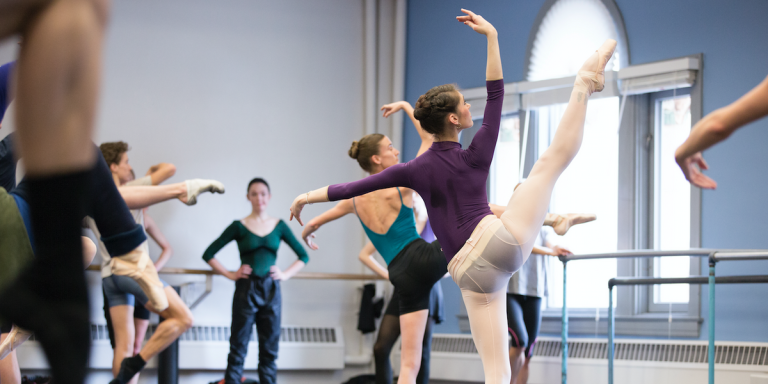
Visual learning plays a foundational role in most dance settings. From the first class onward, dancers are trained to watch closely, track details, and mirror what they see. Demonstration remains one of the most powerful tools in dance education, especially for conveying spatial relationships, timing, and stylistic nuance.
Visual learners often thrive when choreography is shown clearly and repeatedly. Observing how a teacher transitions between steps, uses the torso, or finishes a line provides immediate clarity. These dancers may find it easier to pick up combinations quickly, especially when they can position themselves with an unobstructed view of the instructor.
Mirrors further reinforce visual learning, though their influence is complex. For some dancers, mirrors offer essential feedback, allowing adjustments in alignment, spacing, and coordination. For others, mirrors become a distraction, pulling focus away from internal sensation. Visual learners often benefit most when mirrors are used intentionally rather than constantly.
Visual learning also extends beyond the studio. Watching performances, rehearsal footage, and recordings of oneself can deepen understanding of movement quality and consistency. Visual references help dancers refine style and intention, especially in genres where subtle details define authenticity.
Challenges Faced by Visual Learners
While visual learning offers many advantages, it also carries limitations. Dancers who rely heavily on sight may struggle when visual input is removed or reduced. Performing on unfamiliar stages, adjusting to new spacing, or dancing without mirrors can feel disorienting.
Visual learners may also imitate shapes without fully sensing how the movement should feel internally. This can lead to technically correct but physically inefficient execution. Without attention to weight transfer and muscular engagement, visual accuracy alone may increase the risk of injury over time.
Developing balance is essential. Visual learners benefit from gradually shifting attention inward, learning to trust proprioception alongside observation. This balance allows movement to remain consistent even when visual cues change or disappear.
Kinesthetic Learning in Dance
Kinesthetic learning sits at the heart of dance as a physical practice. Kinesthetic learners absorb information through sensation, repetition, and embodied experience. Movement only begins to make sense once it is felt rather than merely observed or described.
Dancers with strong kinesthetic tendencies often need to try steps immediately, even before fully grasping the structure. Mistakes are part of the process, serving as information rather than failure. Through repetition, muscle memory develops, and clarity emerges from within the body itself.
Kinesthetic learning supports deep retention. Once movement is internalized through physical experience, it tends to stay accessible under pressure. This can be especially valuable during performances, auditions, or high-stress rehearsals where conscious thinking may interfere with execution.
This learning style also encourages adaptability. Kinesthetic learners often respond well to improvisation and exploration, using physical sensation as a guide. Their movement may feel grounded, responsive, and organically connected to music and space.
Physical Feedback and Body Awareness
Kinesthetic learning depends heavily on body awareness. Sensations such as weight, resistance, balance, and breath provide constant feedback. Corrections related to alignment, effort, and efficiency resonate strongly when framed in physical terms.
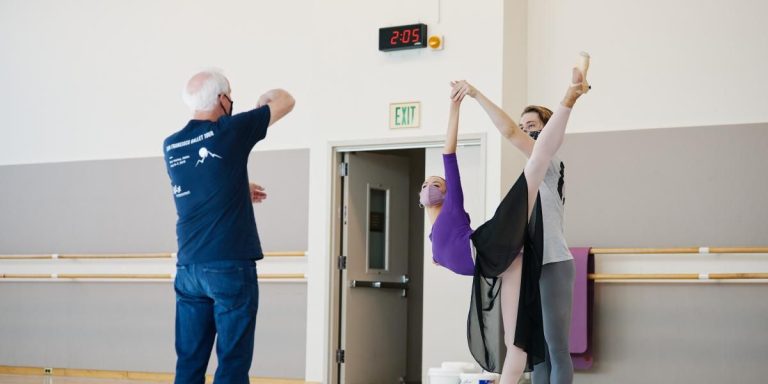
Hands-on corrections, when used appropriately and respectfully, can be particularly effective for kinesthetic learners. Feeling a corrected position often communicates more clearly than verbal explanation alone. Even self-touch, such as placing a hand on the ribcage or pelvis, can reinforce awareness and stability.
However, kinesthetic learners may struggle in fast-paced classes where limited time is given for exploration. When movement changes quickly, there may be little opportunity to physically process corrections. Patience and repetition become essential for these dancers to thrive.
Auditory Learning in Dance
Auditory learning is sometimes overlooked in dance, yet it plays a crucial role in how many dancers process information. Auditory learners respond strongly to verbal cues, rhythmic counts, musical phrasing, and descriptive imagery.
Clear verbal instruction can illuminate movement pathways that visual demonstration alone may not clarify. Imagery such as lifting through water, grounding into the floor, or spiraling through the spine can trigger immediate physical response. For auditory learners, words often translate directly into sensation.
Music itself serves as a powerful auditory guide. Accents, rhythms, and phrasing provide structure and motivation. Auditory learners may feel movement more clearly through sound than through sight, allowing musicality to drive execution.
Auditory learning also supports memory. Recalling a sequence through counts, lyrics, or spoken cues can reinforce choreography retention. This becomes especially valuable in complex routines where visual recall alone may feel overwhelming.
Verbal Cues and Musical Sensitivity
Auditory learners often excel in musical interpretation. They notice subtle changes in tempo, dynamics, and texture, responding instinctively through movement. This sensitivity can enhance performance quality and emotional expression.
Verbal corrections tend to land quickly for these dancers, especially when phrased precisely. Tone, timing, and clarity matter, as auditory learners pick up nuance easily. Inconsistent or vague language, however, can create confusion rather than clarity.
One challenge arises in noisy or crowded studio environments. Competing sounds can overwhelm auditory learners, making it difficult to focus. In these cases, concise cues and intentional pauses become especially helpful.
Combining Learning Styles in Practice
Most dancers are not confined to a single learning style. Instead, they rely on a blend that shifts depending on context, material, and experience level. A dancer may initially learn visually, refine kinesthetically, and perform auditorily, guided by music and cues.
Effective dance education acknowledges this blend. Demonstration, verbal explanation, and physical exploration work best together rather than in isolation. When instruction reaches multiple sensory channels, comprehension deepens and retention improves.
This layered approach also builds versatility. Dancers who strengthen all three learning styles become more adaptable, able to learn quickly in varied environments and respond to different teaching methods. Over time, this adaptability becomes a professional asset.
Teaching with Learning Styles in Mind
For dance educators, awareness of learning styles transforms teaching practice. It encourages flexibility, creativity, and responsiveness to individual needs. Rather than repeating the same explanation louder or longer, teachers can shift strategies to reach dancers more effectively.
A combination of demonstration, verbal imagery, and guided exploration allows students to access material in ways that resonate with them. Asking dancers how movement feels, sounds, or looks invites active engagement rather than passive imitation.
This approach also fosters inclusion. Dancers who may have felt slow or disconnected under a single teaching method often flourish when alternative pathways are offered. Confidence grows as dancers recognize that their way of learning is valid and valuable.
Growth Through Self-Awareness
For dancers, identifying personal learning tendencies encourages ownership of training. Knowing whether visual, kinesthetic, or auditory input resonates most strongly allows dancers to advocate for themselves and seek resources that support growth.
Self-awareness also reduces frustration. When progress stalls, the issue may not be effort or talent but a mismatch between teaching style and learning preference. Adjusting how information is processed can reignite momentum and motivation.
Over time, intentionally developing less dominant learning styles strengthens overall versatility. A visual learner who cultivates kinesthetic awareness gains depth and efficiency. A kinesthetic learner who sharpens auditory sensitivity enhances musicality. Balance becomes a source of resilience.
Learning Styles and Professional Development
In professional settings, adaptability becomes essential. Rehearsal processes vary widely, and dancers must respond quickly to different choreographers and directors. Those who draw from multiple learning styles navigate these environments with greater ease.
Auditions, in particular, demand rapid processing. Visual recall, physical adaptability, and responsiveness to verbal direction often occur simultaneously. Dancers who have trained across learning styles are better equipped to meet these demands confidently.
Beyond technique, learning styles influence communication, collaboration, and leadership within dance communities. Clear expression and receptive listening strengthen artistic relationships and rehearsal efficiency.
The Evolving Conversation Around Learning Styles
The conversation around learning styles continues to evolve, shaped by research, pedagogy, and lived experience. While no single framework captures every nuance of how dancers learn, visual, kinesthetic, and auditory categories offer valuable insight.
Rather than rigid labels, these styles serve as tools for reflection and adaptation. They remind dancers and teachers alike that learning is dynamic, embodied, and deeply personal. Progress emerges not from forcing conformity but from honoring diversity in how movement is absorbed and expressed.
Dance thrives on individuality, and learning styles reflect that truth. Embracing varied pathways to knowledge strengthens the art form itself, ensuring that training remains responsive, inclusive, and alive.
Final Thoughts
Learning styles in dance shape far more than how steps are memorized. They influence confidence, creativity, and the relationship between body and mind. Visual, kinesthetic, and auditory pathways each offer distinct strengths, and together they form a rich foundation for growth.
Dance education reaches its full potential when these styles are acknowledged and integrated thoughtfully. Through awareness and flexibility, both dancers and teachers create environments where movement can be learned deeply, expressed authentically, and sustained over time.